
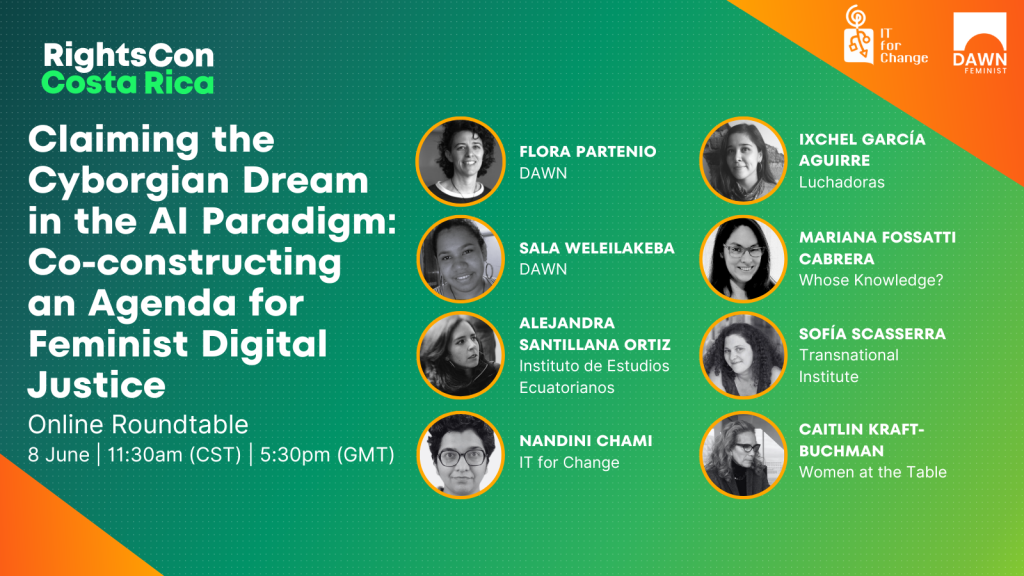
The virtual roundtable on “New Directions for the Declaration of Feminist Digital Justice” was held during RightsCon 2023, Costa Rica. Bringing together members of the Feminist Digital Justice Working Group, alongside co-collaborators from IT for Change and Development Alternatives with Women for a New Era (DAWN) , the session aimed to explore innovative perspectives and paths for the Declaration of Feminist Digital Justice in the ever-evolving digital landscape.
Sofia, working group member and co-facilitator of the Spanish language group, initiated the discussions by addressing the potential of a green paradigm within the realm of digitalization. She highlighted the persistent gap between the promise of digitalization, which was expected to promote gender equality, and the reality of deepening social inequalities in the virtual sphere. The concept of “pink-washing” was emphasized, revealing how our digital structures are often constructed upon foundations rooted in patriarchal, colonial, and capitalist systems.The English roundtable began by stressing the importance of avoiding a technodeterministic approach. Instead, participants advocated for adopting a Southern feminist political economy lens to comprehend the prevailing digital capitalist paradigm.
Both discussion groups unanimously recognized the Declaration of Feminist Digital Justice as a crucial roadmap for igniting political debates. This discourse aims to transform the digital sphere, moving it beyond its role as a breeding ground for inequality. Central to this dialogue is the question of whether technology can effectively challenge the entrenched trifecta of patriarchal, colonial, and capitalist dominance, transcending its focus on minority concerns and hate speech to address broader transformational potential.
Throughout the event, several critical themes emerged from discussions in both English and Spanish groups:
Challenging Tech Paradigms: Participants expressed concerns about the exploitation of bodies and relationalities within tech paradigms. They raised alarms about the rise of new forms of reproductive surveillance and their potential harm to marginalized communities.
Technodesign for Gender Justice: The concept of “Technodesign” was introduced as a means to address gender justice beyond conventional issues of bias and discrimination. Participants delved into cognitive justice and explored strategies to tackle these complex challenges.
Unchecked Corporate Power: A recurring concern centered on the unchecked corporate power in the digital space. Despite the internet’s critical role as a platform for rights-bearing citizens, it remains unregulated and monopolized by large tech companies. Participants emphasized the urgency of establishing platform architecture and social care economies to counteract corporate dominance and create a more equitable digital environment.
Redistributive Justice and Data Commons: The concept of redistributive justice was scrutinized, leading to a collective call for defining a true data digital commons. Discussions addressed issues of open washing and data extractivism, advocating for more ethical and equitable data practices.
Members from the Feminist Digital Justice working group also shared their valuable insights and visions to shape the future of feminist digital justice:
Caitlin from Women at the Table emphasized the importance of intertwining environmental issues with digital justice and exploring new economic models.
Mariana from Whose Knowledge? highlighted the adaptability of the declaration, seeing it as a versatile tool to engage various social justice movements and fostering dialogue at multiple levels.
The floor was then opened to additional input from the roundtable participants:
Ixchel from Luchadorxs emphasized that the declaration goes beyond being a mere tool; it serves as a catalyst for transformation and introspection, promoting reciprocity and solidarity in a digital society.
Ushnesh prompted discussions on cultural translations and effective communication to bridge the gap between principles and everyday experiences.
In terms of next steps, the event concluded with calls to develop an engagement toolkit. This toolkit would facilitate meaningful discussions, promote understanding of feminist digital justice principles, and encourage dialogue across various levels, from grassroots to higher governance. The primary aim of expanding the declaration into other forms is to translate technical knowledge for non-technical audiences and share insights with diverse communities to reinterpret the declaration’s principles.
Participants expressed their dedication to advancing feminist values in the digital sphere, envisioning the declaration not merely as a policy tool but as a means to engage with other social justice movements, ultimately driving impactful change on local and global scales.
In closing, the event generated fresh insights and innovative ideas on how to translate the Declaration of Feminist Digital Justice for different audiences, marking a significant step towards a more equitable and just digital future. The roundtable participants engaged in a thought-provoking exercise, envisioning their digital future by reflecting on the question, “feminist digital justice means this to me.”
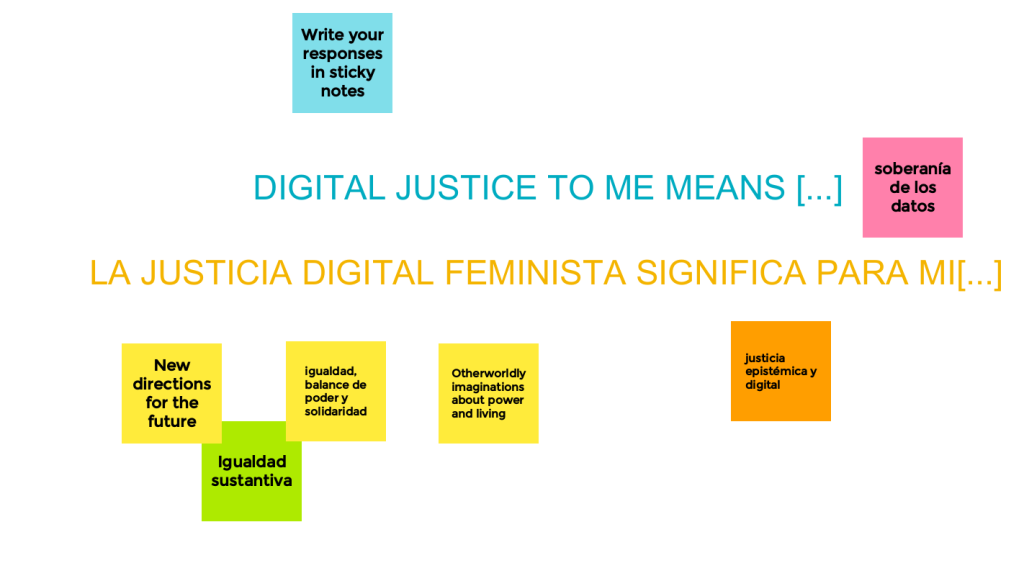
A snapshot of the ideation board with quotes on what digital justice means to some of our roundtable participants
The co-facilitators expressed gratitude to all participants for their valuable contributions and emphasized the importance of continued collaboration to realize the shared vision of a just and equitable digital future.